Published on · By GREATER
BJJ belts: order, ages and time at each rank
In Brazilian jiu jitsu, adults go through five belts (white, blue, purple, brown and black), and kids have their own colour system up to age 15. The IBJJF sets the minimum age and minimum time at each rank, but it's your coach who decides when you get promoted.
The adult BJJ belt order
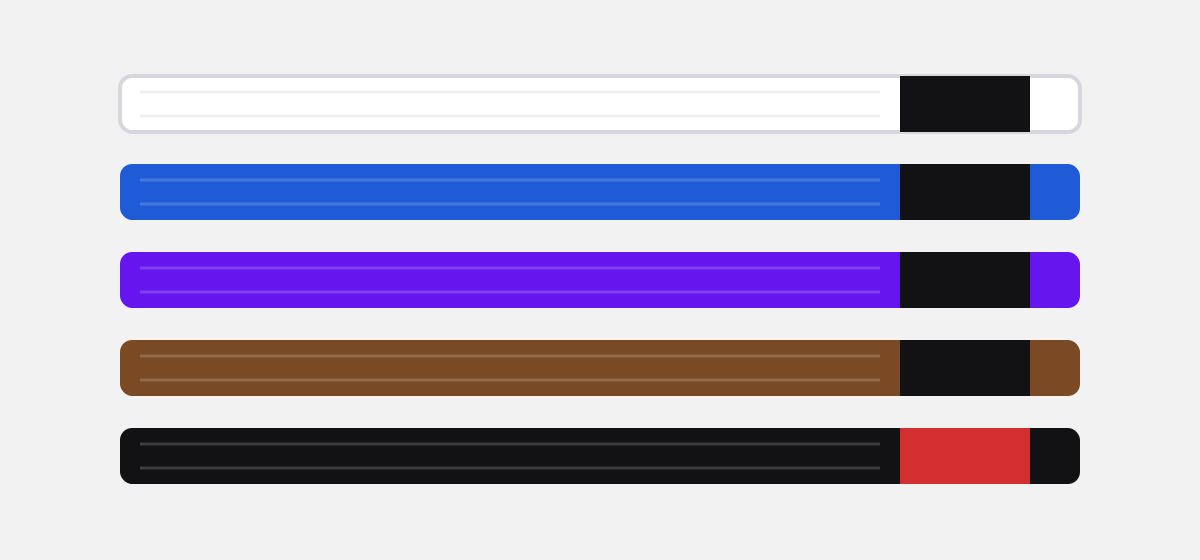
| Belt | Minimum age | Minimum time before the next one |
|---|---|---|
| White | No minimum | No set minimum |
| Blue | 16 | 2 years |
| Purple | 16 | 1.5 years |
| Brown | 18 | 1 year |
| Black | 19 | 3 years between degrees up to the 3rd; 5 years from the 3rd to the 6th |
These are minimums, not the norm. In practice, most people take a good deal longer than these periods added together to reach black belt. It depends on how much you train, your academy and your coach.
There is one exception: according to the IBJJF, an adult world champion at blue, purple or brown belt doesn't have to complete the minimum time at that belt.
After black: degrees, coral and red
The black belt has degrees, marked with stripes. Up to the 3rd degree you need 3 years between each one, and from the 3rd to the 6th, 5 years between each degree. Beyond that the periods get longer, leading to the coral belt (red and black, then red and white) and the red belt, which is reserved for those who have dedicated decades to jiu jitsu.
Kids jiu jitsu belts (ages 4 to 15)
Kids can't wear a blue belt until they turn 16. Until then they use four colour groups. Each group has three belts: with a white bar, solid, and with a black bar.
| Group | Ages |
|---|---|
| Grey (grey-white, grey, grey-black) | 4 to 15 |
| Yellow (yellow-white, yellow, yellow-black) | 7 to 15 |
| Orange (orange-white, orange, orange-black) | 10 to 15 |
| Green (green-white, green, green-black) | 13 to 15 |
At 16, the student moves into the adult system. Which adult belt they get, based on the kids belt they held, is set by the IBJJF graduation system.
What stripes are (the "degrees")

Stripes are the strips of tape on the black bar of the belt. There are usually four per colour, and they mark progress from one belt to the next. The IBJJF doesn't require them: each academy decides whether to use them and when to award them. Some give them based on time, some on the number of classes and some when they see technical progress.
How coaches decide when you get promoted
- Attendance and consistency: how many classes you've done since your last promotion (here's how attendance tracking in an academy works).
- Technique: what you've mastered at your level, standing and on the ground.
- Sparring: how you hold up against training partners at your level and above.
- Attitude: respect, helping newcomers and being a good training partner on the mats.
To compete in IBJJF tournaments, the coach who promotes you must be a black belt and registered with the federation.
Frequently asked questions
How long does it take to get a black belt in jiu jitsu?
Adding up the IBJJF minimum times, at least 4.5 years from when you get your blue belt (white belt has no minimum), but it usually takes a lot longer. It depends on how much you train and on your academy's criteria.
What is the BJJ belt order?
For adults: white, blue, purple, brown and black. For kids: grey, yellow, orange and green, each with three variants.
Can a kid be a blue belt?
No. Blue belt starts at 16. Before that, kids progress through the kids belts.
Are stripes mandatory?
No. The IBJJF suggests them, but each academy decides whether to use them and how to award them.
Sources: IBJJF · General Graduation System (2022) · Graciemag · IBJJF · Minimum graduation period update · Wikipedia (accessed 27 October 2026).